The following text and photos are from Bruce Zamost, posted with permission. He documents the differences between the 2 known types of the iconic World's Series pinball machine, the "Champion model", and the primary production model.
 |
| left: World's Series Champion model right: World's Series production ('Second') model |
 |
| Champion model |
 |
| full production model |
Playfield and mechanical variations on the Champion Model include:
- words "Champion Model";
- slimmer baseball graphic at top;
- 2 top players are higher (left side player's shoe is covered by ball return hardware);
- black lines around baseball diamond are absent;
- base labels are shown in divided backgrounds;
- different font, e.g. "RUNS";
- wire baserunner covers vs. nylon tabs;
- shadow behind down arrows above register are absent;
- yellows on production model playfield are orange on Champion Model---this includes the disc paint as well;
- different pin quantities in clusters both in upper and lower playfield;
- register casting lacks 2 integrated uprights and instead utilizes 3 separate, discrete lane guides above register;
- tilt lock-out rod;
- trough has differently oriented bell holes and bell brackets, no bells and holes are mysteriously covered with sheet metal;
- extra bracket on trough;
- 2 screws flanking baseball diamond are absent.
Differences in mechanicals noted as follows: [each bulletpoint relates to highlighted sections in the subsequent photographs -- cait]
- Red: trough bells absent on Champion and bell hole orientation different.
- Green: tilt rod with larger rear bracket present on Champion. Front tilt bracket on production model has hole for accepting tilt rod even though that rod wasn't utilized on production models or at least on the vast majority of them.
- Amber: larger cut out at tilt mechanism on Champion model.
- Yellow: RWS 1 (Rockola World's Series 1) stamped on arm trough of Champion. RSW 1A stamped on receiving basin of trough on production model.
- Blue: bracket instead of spring on prototype.
- Other: additional securing screws on board on production model on top side. This Champion board was drilled for use as a playfield as evidenced by pin holes. Also, the prototype features the machined randomizer gear as opposed to a cast gear which I neglected to encircled but which can be seen in the photos.
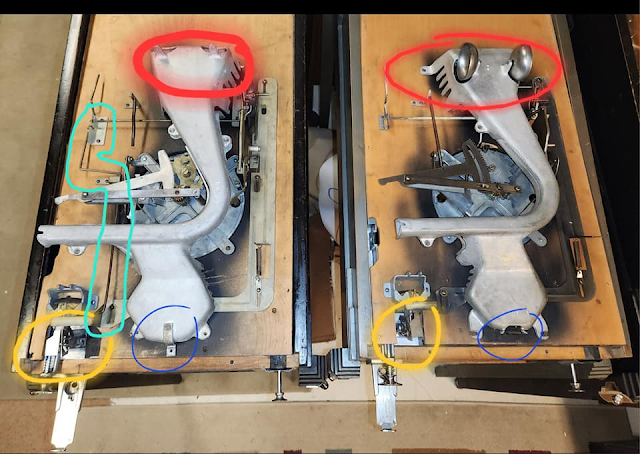 |
| Red: trough bells absent on Champion and bell hole orientation different. Green: tilt rod with larger rear bracket present on Champion. Front tilt bracket on production model has hole for accepting tilt rod even though that rod wasn't utilized on production models or at least on the vast majority of them. Amber: larger cut out at tilt mechanism on Champion. |

