1961 - 豚と軍艦 / Buta To Gunkan (Pigs and Battleships) 1964 - 夜の片鱗 / Yoru no Henrin (The Shape of Night) 1968 - 喜劇初詣列車 / Kigeki hatsumoude resha (Comedy Hatsumode Train) 1976 - やさぐれ刑事 / Yasagure Keiji (Outlaw Cop) 1976 - 君よ憤怒の河を渉れ / Kimi yo Fundo no Kawa o Watare (Manhunt) 1979 - 復讐するは我にあり / Fukushū Suru wa Ware ni Ari (Vengeance Is Mine)
Here are even more videos I am enthused about. (previously: part 1, part 2)
Not quite EM, but still
start at the 8:00 mark of this video to get a technical tour of the Holly Crane from 1940, a USA crane that would later inspire the Japanese crane machines of the 1960s like Sega's Skil Diga.
The Imperator is one of my favourite slot machines of all time, and you'll quickly see why.
I had a custom table/shelf built to better house my pre-war pins. Check it out!
88" long
I can't stress enough how much my gameroom is a collaboration. There is basically nothing I could have done here by myself, and I am very grateful to the wonderfully supportive arcade/pinball community and their patience and generosity.
I have many friends who have worked on my machines, helped me move machines in and out, helped me transport machines, have given me knowledge and wisdom, and let me rant in their general direction. Without all of their assistance, this space would just be all storage.
I don't think I've mentioned it here before, but when I turned 40 I developed aggressive and severe cataracts and went fully blind in one eye before I got surgery. I healed ok, but in order to maintain my ability to drive I needed two lenses with very different focal lengths, thus making near-sighted correction impossible. I am no longer able to see things with precision close up with binocular vision. I might try a jeweler's loupe for the one ok near-vision eye, but I've lost all binocular vision for precision.
The reality of this sunk in went I had to adjust a basic rollover switch on Dolly Parton. Try as I might with different angles, illumination, and visual tools, I was unable to tend to the switch with any precision. My days of being an amateur pinball tech are sadly behind me, and that kind of feels like shit to say. Even the clunkiest of lug soldering is now impossible.
In response, I've obviously leaned very hard into the research aspects of the hobby, but oh I miss the satisfaction of aligning an AX relay. When the pandemic came, I made sure to come up with a plan to have my arcade stuff taken care of in case I died. I felt better to have a plan to ensure my family wouldn't be encumbered by a room full of arcade stuff.
I am so very grateful to still be here, to have regained some vision in my eyes, and to have had the chance to build a gameroom like this. I am grateful for all of my friends and acquaintances in the hobby who have assisted me, and the number of people and what they have done is large.
My collection pays tribute to an aesthetic I had been chasing since a young child. I am mostly into pinball, but the aesthetic root is actually kinetic ball devices. Very specifically, this was all the result of being taken to Expo '86 and witnessing the premier of Swiss Jolly Ball by mechanical sculptor Charles Morgan.
It was that spark of joy and inspiration that my collection is in service to.
The following text and photos are from Bruce Zamost, posted with permission. He documents the differences between the 2 known types of the iconic World's Series pinball machine, the "Champion model", and the primary production model.
left: World's Series Champion model right: World's Series production ('Second') model
Champion model
full production model
Playfield and mechanical variations on the Champion Model include:
words "Champion Model";
slimmer baseball graphic at top;
2 top players are higher (left side player's shoe is covered by ball return hardware);
black lines around baseball diamond are absent;
base labels are shown in divided backgrounds;
different font, e.g. "RUNS";
wire baserunner covers vs. nylon tabs;
shadow behind down arrows above register are absent;
yellows on production model playfield are orange on Champion Model---this includes the disc paint as well;
different pin quantities in clusters both in upper and lower playfield;
register casting lacks 2 integrated uprights and instead utilizes 3 separate, discrete lane guides above register;
tilt lock-out rod;
trough has differently oriented bell holes and bell brackets, no bells and holes are mysteriously covered with sheet metal;
extra bracket on trough;
2 screws flanking baseball diamond are absent.
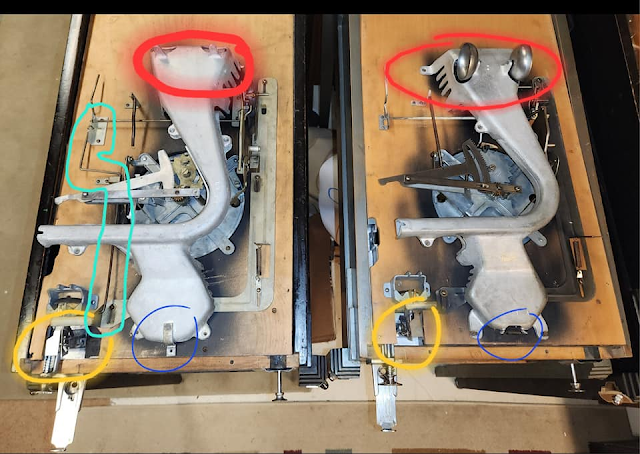
Differences in mechanicals noted as follows: [each bulletpoint relates to highlighted sections in the subsequent photographs -- cait]
Red: trough bells absent on Champion and bell hole orientation different.
Green: tilt rod with larger rear bracket present on Champion. Front tilt bracket on production model has hole for accepting tilt rod even though that rod wasn't utilized on production models or at least on the vast majority of them.
Amber: larger cut out at tilt mechanism on Champion model.
Yellow: RWS 1 (Rockola World's Series 1) stamped on arm trough of Champion. RSW 1A stamped on receiving basin of trough on production model.
Blue: bracket instead of spring on prototype.
Other: additional securing screws on board on production model on top side. This Champion board was drilled for use as a playfield as evidenced by pin holes. Also, the prototype features the machined randomizer gear as opposed to a cast gear which I neglected to encircled but which can be seen in the photos.
Red: trough bells absent on Champion and bell hole orientation different. Green: tilt rod with larger rear bracket present on Champion. Front tilt bracket on production model has hole for accepting tilt rod even though that rod wasn't utilized on production models or at least on the vast majority of them. Amber: larger cut out at tilt mechanism on Champion.
2 more items purchased from Japan, graciously scanned by the lovely preservationist @hubz of GamingAlexandria fame.
The first one is an overview of the industry, released by a magazine that published beginning 1951. This publication is from 2011. It includes many rare photographs, even from before 1951. My favourite section is the collection of advertisements from each of the eras.
It also includes an article that references Nic Costa and Kazuo Sugiyama!
This next one is a brochure from a Pachinko Museum that was operated by a pachinko industry association. It is primarily focused on the mainstream pachinko industry, and does not include much information on Corinthian, smartball, arrangeball, sparrow ball, issen pachinko, or any of the other topics I am more interested in.
I would like to learn where the museum collection went. They have a large repository of magazines, and I need to access all of the information in these magazines!
If you have any further information, I would like to confirm which episode this is so we can confirm the date this episode aired. If it was in 1971 (or earlier!) that pushes the date forward on at least 2 machines.
This a wonderful arcade, with a few machines I have not seen in a real arcade before! Let's dive in.
First, we start at the pachinko side of things. It's about what you'd expect of a standard pachinko parlor of 1971, though they don't show us much of these machines.
On to the arcade, where we begin with every editor's favourite cut: Untouchable! You'll remember that this same style of cut (where we cut directly to arcade action) was also done in 愛欲の罠 (exploring the arcade in 愛欲の罠 / Aiyoku no wana aka Trapped in Lust (1973)). This even includes footage of Sega's Jockey Club, which was also included in the Trapped In Lust arcade action montage.
1971 Untouchable - アンタッチャブル by 関西精機 (Kansai Seiki — Kasco)
Nic Costa is one of the premier researchers of coinop history. Similar to what Dick Bueschel achieved in the USA, Nic Costa pursued with the UK's (and world's) coinop history.
The archive is currently in version 1.1 but I hope for this to be an iterative process. Currently none of the files have useful names, but there is now a folder structure setup to help assist finding information. One purpose of the archive is to help inform the world of the materials within. For example, pages of negatives are scanned in, but the negatives themselves have not undergone preservationist scanning. Likewise, some of the materials found within are done with quick scans, not preservationist scans.
Since the research is centered around UK/Europe, countries outside of that range like USA and Japan often have their own folders. The sorting system I set up is still quite preliminary.
Here is the current folder structure:
flyers & photos & misc
allwin backflashes
flyers, ads, catalogues (UK, europe)
Japan
magazines, newspapers, articles
misc
paper, scraps, letters
Photographic Views Phototype Derbyshire
postcards
Samson Bolland Holloway (family interviewed late 1970s)
Stereoscopic and Mutoscope nudes
The Album of Folkestone
USA
index cards
Arcade Locations
Coin-op Articles
Companies - [A through Z]
Companies French
Companies German
Companies US - [A through I -- more sorting needed]
To begin, I want to give examples of the last 2 main folders, so we are going in a somewhat reverse order.
The "photo slides & negatives" folder contains scans like this:
The "index cards" folder is a database in paper format. This is a wonderful glimpse in to how research would be conducted before the days of affordable and readily accessible computers.
Companies - C Caille Brothers
Machine Types Strength
Machines - M Miniature Cricket
People - W Whales, Oliver
There are many wonderful bits of ephemera to be discovered in "flyers & photos & misc". Within there are a handful of subfolders, and let's just glance at a few of the things we find: