Showing posts with label american bagatelle. Show all posts

Saturday, January 18, 2025

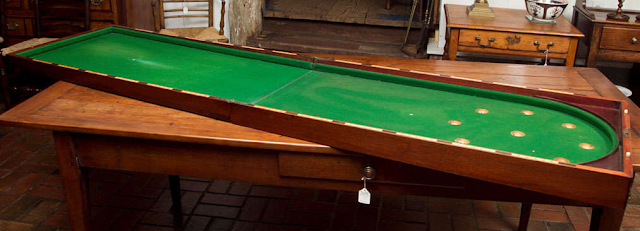
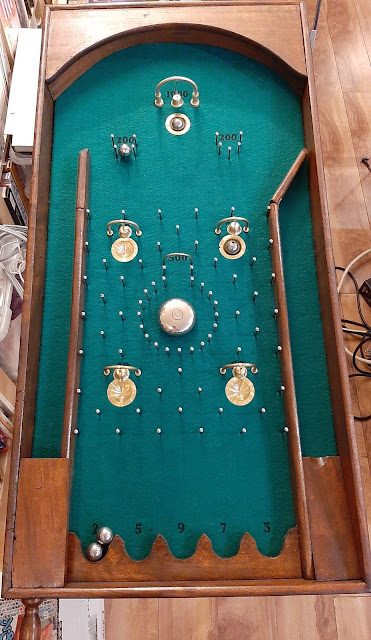
Klondike Pool table

Earlier this year I was contacted by Gary Wasielewski (who writes at Crokinole Chronicles) about a Klondike Pool table he had picked up.  He agreed to let me document it on the blog.

Playfield details


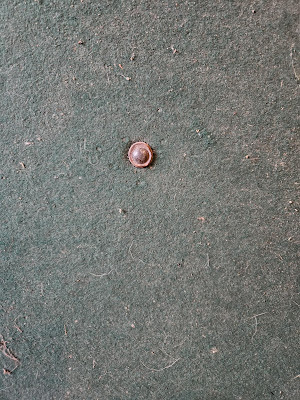
Near the center-top of the playfield is what looks to be a divot to place a King ball for a game like cockamaroo.  But instead it looks like a button, and it makes it hard to balance a ball there.  Perhaps it's like that to make the 2nd ball precariously balanced, and thus easier to dislodge?


The trap hole mechanism

The counter weight returns the plug back to the hole once dropped


rotated photo, showing the trough beneath the trap holes

Lower playfield arches


 Front trough, cigar holders, and cue ball cup/rest


 Balls
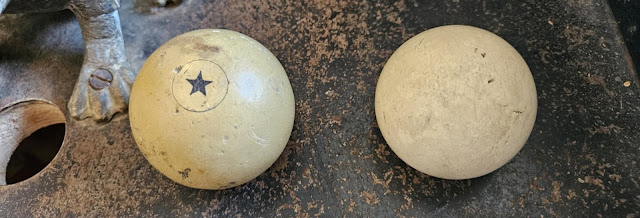

he suspects that only the speckled balls are original.


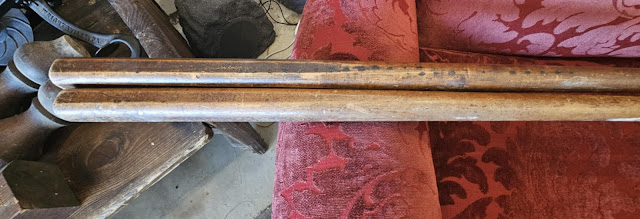
 Cues


Legs


From Gary, on the provenance: 

"The last owner, who I never met but have tried to get the auction house to have contact me, shared that it was in a plantation house on site of Monocacy in 1864 and then at a hotel in Atlantic City (the Royal Palace) which was around in the late 1890s/1900s. The hotel is written in chalk at the bottom.

I do not know if Klondike Pool tables like this were sold as far back as 1864, but the evidence of the Royal Palace Hotel in Atlantic City does lineup with the known timeline for Klondike pool.


Bonus photo, a different Klondike Pool table that was sold earlier in 2024 in Quakertown PA USA.


------------------------------------------------------------------------------

For my readers in the USA:  

This blog stands in solidarity with trans people in the USA, and my work here only continues as an active site of protest.  The fabricated moral panic against LGBTQ people offers severe state violence in the form of eradicating gay/bi/queer people, but especially trans people, from public life. Talk to the trans people in your life about what they are going through.  Find ways to assist the trans community in the face of this genocidal moral panic that threatens the existence of millions, and is being implemented out of malice, ignorance, and fear.

Trans Rights Are Human Rights

 Recommended reading: Shroud Waving
Friday, December 2, 2022

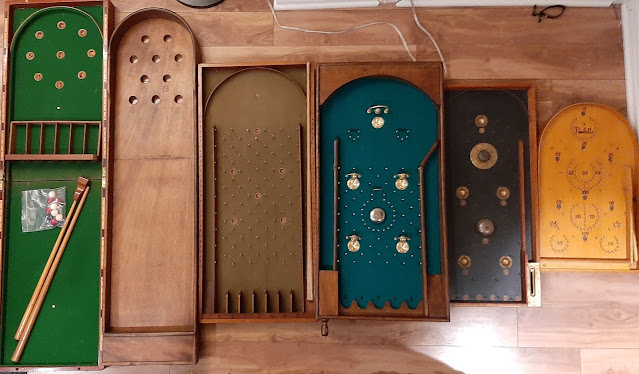
the teeny tiny table games

There's 10 of them now.  10!


How did this happen?  A Redgrave bagatelle had been on my wantlist for a while.  Then shortly after I discovered an auction in the UK for a scaled-down bar billiards table at a good price, and I had to go for it.  I do not think that the Singer bagatelle will be sticking around.


For the sake of discussing them, I will number them.  Tables number 1, 2, 5, 6, and 10 are all miniature / toy versions of tables that are regularly full-sized, usually 7-10 feet in length.  Tables 3, 4, 7, 8 and 9 are all made for the home parlor / toy market.


  1. Cockamaroo: Seems to have began early 1800s.  Left and right shooter lane, and uses a cue or mace for both.  Place a King Ball at the top dot, and then there are 6 cups to land in on the way down, plus scoring columns along the bottom.
  2. Pin bagatelle with plunger, first seen mid 1800s.  An example of how bells were introduced into the game.  Dual shooting lanes, with one for the plunger, one for shooting with a cue.  There is no King Ball spot here.
  3. 1876 Redgrave bagatelle.  First USA patented coiled spring plunger from the front of the table, the way we now know with contemporary pinball.
  4. Singer bagatelle: different style of plunger to avoid Redgrave's patent.  This has scoring slots along the bottom, a remnant from cockamaroo that would disappear by the 20th century.
  5. 9-hole English bagatelle:  the classic English Bagatelle layout, 1 center cup encircled by 8 others.  Still played within some parts of the UK and USA.
  6. Japanese rolling ball table: by 1870 there were variants of the English Bagetelle table sold that had cups in multiple lines.  In Japan, early meiji era, tables like this were used for ball rolling, and points exchanged for prizes.  This is the birth of modern redemption arcades.
  7. Japanese rolling ball toy:  After the success of Japanese Rolling Ball in the USA, toy versions were sold from the 1900s to 1950s, though only some models had references to the Japanese origin.
  8. Poolette: post-ww2 bagatelle toy from Japan, similar to Corinthian tables popular in the early 30s
  9. 20th century bagatelle toy from the UK.  Corinthian style board, but with springed plunger and bakelite (maybe) plastic surface.
  10. Bar Billiards: supposed "arriving from the Dutch" in the 1930s, bar billiards is still popular in parts of the UK today, as well as in a few other countries.  Sometimes referred to as "Russian Billiards", the game has under-table troughs to bring sunk balls to the labeled point slots at the front.

Thursday, June 16, 2022

lining up the bagatelles


1: English bagatelle / 9 hole bagatelle (UK)
2: Japanese Rolling Ball / Tamakorogashi (Japan)
3: Cockamaroo / French bagatelle (UK)
4: French bagatelle (France)
5: Singer parlor bagatelle (USA)
6: Poolette bagatelle (Japan)


How did we get here?

Well before all of these you'd find the early billiards variants, including trou madam.  On table (1) there lies a set of wooden gates, allowing one to play trou madam and similar games on that table.  English bagatelle, with the inlaid cups, seems to have sprung up early 1800s.

In the 1870s there is evidence of tables like (1) being made with holes in parallel rows, akin to (2).  I think these tables were the inspiration for Japanese Rolling Ball, which came up around 1880 in Japan, 1902 in USA + Canada, and then about 1930 within Europe.

If you note the bottom scoring slots in table (3), you'll they're quite similar to the wooden gates available on (1).  A key innovation would be taking a trou madam table and putting it on an incline.  Shoot the balls up, and have them fall down in to the separated scoring arches.  I am currently unsure if that innovation predates English Bagatelle (1) but it also seems like the kind of innovation that could have happened at in a number of eras and in a number of different areas.

It can be easy enough to infer how the cups of (1) migrated along the playfield of (3), the pigeon hole arches going to the bottom, and then pins added as obstacles.

Table (4) adds a spring plunger on one side, and maintains a cue lane on the right-hand side.  Table (4) also has arches, which were an accessory to some billiards games going back to the 17th century at least, but were perhaps an innovation that was once again fresh at the time.  Bells are also a new addition.

Table (5) does away with the cue altogether, relying exclusively on a spring plunger.

Table (6) is an example of how for some games the cue was kept instead of a spring plunger.

Wednesday, June 15, 2022

early 20th century bagatelle restoration

Check out this full bagatelle restoration by Old Things Never Die

This video is just guessing at the age being 1930s.  There is circumstantial evidence that models of these specifications, and with only a few slight variations, were sold at a famous Paris toy store.  

Remember this toy 9-hole bagatelle table I picked up?  That one at least had the Hamleys plaque on it, and I was able to find it in a picture from an old catalogue.  

For this new one, it seems the toy store that commissioned them had their labels in paper, which is very bad at surviving.  So we have an inference that this might have been sold at that Parisian toy store, as other copies were.  Based on the build and available information about the store, I'd only be confident in giving an estimate of 1900-1920s.


I guess I buried the lede there.  I was able to purchase this table from the restorer, and it has safely arrived from France.


Ball sizes

The game arrived with ~19.9mm steel balls, approx 25/32".  This would require a very full plunge to get some action from the spring plunger.  Steel balls would also not be good to launch with a cue from the right lane.

I tried 7/8" balls, which are 22.23mm, but those were too large.  If one ball was in a brass cup, another could be caught between the ball and the gate post.  I tried plastic balls and marbles, and using light balls made the plunge much better.

I have begun using 3/4" marbles.  That works fine for now, but 3/4"  is 19.05 mm.  I would like to try and find some more appropriate balls that get up to the 19.9mm size, if possible

Wednesday, January 26, 2022

assembling the bite-sized bagatelles

 coming to a pinball history booth near you.... someday...


banana for size

Left to right:
  1. Singer parlor bagatelle (spring-loaded plunger shooter, but it's missing)
  2. Poolette (small cue to launch balls)
  3. French bagatelle / cockamaroo (balls launched from left/right troughs using a cue)
  4. 9-hole English bagatelle (balls hit with mace or cue)
  5. Japanese Rolling Ball (balls rolled by hand)

Monday, October 18, 2021

on naming the bagatelles

It is hard to definitively understand the world of billiard variants.  The game(s) travelled the world many times over, some names were only used in certain regions, some regional-sounding names were given with little-to-no connection to those territories, and many times historical sources would naively swap names around.

This is another work-in-progress post where I'm going to try and collect some details, but I propose a singular takeaway: LET'S STOP CALLING THINGS "BAGATELLE".  Please?  Bagatelle is a toy home pinball game, it's a musical number, it's a literal TRIFLE synonym, it's a billiard board, it's an antique pin board, it's enough things.   Let's be more specific.


Quick summary of the styles I'm interested in:

9-hole bagatelle / English Bagatelle:  long and thin tables where you shoot from one end to pocket balls in the 9 shallow holes on the playfield.  These tables come up for sale somewhat regularly in the UK, and the folding versions come up occasionally in USA.  You don't often see it referenced as "9-hole bagatelle" but I am calling it that because it's explicitly descriptive.
My entry on 9-hole English bagatelle


Pin Bagatelle / French bagatelle / Parisian bagatelle / Russian Bagatelle / cockamaroo: a slanted table where balls are shot up a channel and then fall down through pins/pegs.  Full-sized tables of this type seem to be very rare / obscure, with smaller toy-sized versions being rather common.  Features like shooting method, playfield gimmicks, and score holes vary, and I use "pin bagatelle" as an overarching category covering these variants.
My entry on pin bagatelle / French bagatelle


Klondike Pool / Tivoli Table / American Bagatelle / Manhattan:
very similar to other pin bagatelles, except it employs a holes and a trough system to delivery the balls to the front.  Pretty obscure, but at least some copies are known to exist.  Late 19th century, and primarily American.
My entry on pin bagatelles includes a section on Klondike Pool


Japanese Rolling Ball / Tamakorogashi (玉ころがし) / Billard Japonais / Japanese Billiards: a long table like 9-hole bagatelle, but with holes arranged in rows and given a larger range of point values.  Typically the end of the table is rounded, but sometimes it is rectangular.  No cue is used, balls are rolled by hand.  Many home-made ones exist due to their ease of construction, especially in parts of Europe where it still has popularity as a fair game.
My entry on Japanese Rolling Ball


Pigeon Hole / Trou Madam / Parepa:  has holes to shoot through at one end.  Many 9-hole tables also had an add-on to make it a pigeon-hole table.  Dedicated tables of this type are very rare / obscure, especially the angled Parepa tables.  Pigeon-hole is more often played on English Bagatelle tables by inserting a wooden bridge.
The dedicated Pigeon Hole tables have a trough under the playfield that returns the balls to the front of the table, same as bar billiards.
My entry on pigeon hole / trou madam / bar billiards

1872 J. M. Brunswick catalog

Most billiard tables can be converted to a table like this by adding a wooden arch made to fit across the narrow cross-section of the playfield.  The game Trou Madam, dating to the 16th century, can have arches like this, and games like Mississippi are played in this manner.

Carombolette:  a variant of pigeon-hole that adds a pin-bagatelle feature on the other side of the gates.  These are very rare / obscure.  The stopper pictured below would allow the table to be played purely as a pigeon hole table.
My entry on carombolette


Bar billiards / Jenny Lind / Russian Billiards: Balls are shot from the front and into holes which channel the balls back to the front of the table.  Played with "skittles" (wooden pieces) on the playfield to avoid.  Common, still made and played today.
My entry on bar billiards
some videos on bar billiards

Jenny Lind Table - holes in the table direct balls to trough at the front
1872 J. M. Brunswick catalog 


Some other table games:

Toupie Hollandaise: no strong connection to billiards or bagatelle, but I'm including because people often lump these in with antique bagatelles.  It has skittles on a flat playfield, to be knocked over by a spinning top.  Also exists as a children's versions.
My entry on Toupie Hollandaise


Bowling Naco:  balls are rolled down and their angle modified by changing the shooter's angle.  Exists as a large parlor game, very popular in children's toys, and also exists as coin-op games.  Including here because it was made into a coin-op game in the 1930s around the time when pin bagatelle went coin-op too.