Part of my teeny tiny bagatelle table collection was featured in this Polish article on the history of bagatelle. I also answered a few of the questions from the author.
 |
| PSX Extreme 2023-08 (312) |

 |
| article by Łukasz Dziatkiewicz |

Part of my teeny tiny bagatelle table collection was featured in this Polish article on the history of bagatelle. I also answered a few of the questions from the author.
|
| PSX Extreme 2023-08 (312) |
|
| article by Łukasz Dziatkiewicz |

Hosted be 谷啓 (Kei Tani,) this aired on Nippon TV January 1992 and features Dick Bueschel (USA), Nic Costa (Cyprus), André Simon (France), and 遠藤嘉一 (Kaichi Endo, Japan,) amongst others.
Annotations provided by Kazuo Sugiyama.
Translation assistance by Ladios.
Thank you Simon Prentis (original English & Japanese interpreter in the TV show) for the video.
Additional notes and editing by Caitlyn Pascal.
The ball spirals further inward! We're not talking about machines that use circles or curves or even spirals to launch balls, no these are machines where the spiral is everything.
There is so much that can be done with spirals! the ball spins around the spiral and the spiral comes up spiral. But spiral all spiral spiral? Spiral indeed spiral! Spiral spiral, spiral spiral spiral spiral.
 |
| 1929~ 自動販売球遊機 (An automatic vending ball game) [No. 17] by 日本娯楽機製作所 (Japan Amusement Machine Manufacturing) |
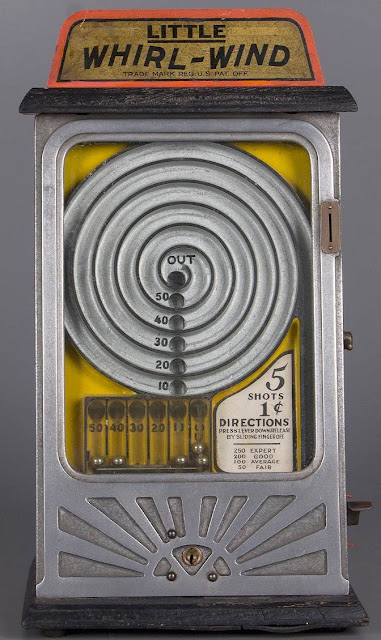 |
| 1930 Little Whirl Wind by Peo |
 |
| 1930 Play Ball by Pace |
Today I got home from an epic trip to the Whiterose Gameroom Show aka The York Show. It was an 8.5 hour drive and oh god that was numbing. At least the highway was well maintained and unremarkable for the vast majority of the drive. I had planned to do it over 2 days, but didn't want to spend the extra money on one more night at a motel. Though I did stop at a hotel on the way home as to maximize my time at the show.
I had arranged a fairly epic trade. I traded 3 prewar machines and a game stand from the 1930s for a toupie hollandaise table, estimated to be from the late 1800s. Click the toupie tag at the bottom if you want to see more examples, but quick answer is that it is a spinning top game where you fire off the spinning top and hope to knock down the skittles.


The other highlight was getting to play a number of P3 games thank to Nick Baldridge. He was there with his beautiful P3 module Drained. The left machine in the photo includes the full art package with an incredible speaker plate art package.
The build quality is surreal on these, but what won me over was the idea that pinball could capture that smaller-scope fun again. Let me explain: Modern pinball machines start at $7500 USD for a Stern Pro and go up far higher, and players demand epic game depth for that kind of coin. But talk to the hordes of people who spent the weekend primarily playing games from the 50s to the 90s, and sometimes you just want pinball to be a 3-7 minute game, not potentially a 30+ minute epic quest. (Sure, balls times are quick on location on new machines, but if you have a modern machine at home you're going to learn the shots quite well)
With the cost of a new module at $3500, P3 lets you swap in entirely new games for less than the price of a poorly-playing Rollercoaster Tycoon 3 rows away. A game like Drained is tonnes of fun and harkens back to the ethos shared by the EM machines the playfield is inspired by. The only other modern game I can think of that channels that earlier-era pinball experience is Total Nuclear Annihilation. Perhaps Pulp Fiction (and would Bond 60th count?) also has that feel, but I haven't played it yet. If you appreciate the game play of TNA, definitely give Drained a try.
I still haven't played the big games for the platform: Weird Al, Heist, and Final Resistance, and even without considering them I still have to gush about the quality of the P3 platform. For someone like me with a galley arcade, I have to add P3 to my list of dream machines. (though I doubt I could get it down my stairs without breaking it down into smaller pieces)
 |
| Nick Baldridge next to Drained on a P3 with the art package installed. The right machine was running Drained: Bite-Sized, a boss-rush mini game that can be bought for the custom Drained module. |
 |
| Venom Premium by Stern |
Some other game highlights:
 |
| 1947 Singapore by United Not only was this game flipperless (though some copies that exist were retrofitted, since this game was released shortly after Humpty Dumpty) this game also has no plunger. The player must roll the balls up the glass where the fall into the playfield at the top. |
 |
| rule card |
 |
| this game would normally have an upper plane of glass preventing a player from dropping the balls in directly at the top, greatly increasing the difficulty. |
 |
| the wonderfully unique ball lifter & ejector |
 |
| Years before he designed games for the P3 platform, Baldridge created the Multi-Bingo (right) and Multi-Races (left). These remarkable machines let you play all of the bingo and one-ball horserace games with the original gameplay hardware, with the backglass and logic done by computer. I spent a lot of times around these two games, helping people learn about these gambling machines from the 40s and 50s+. |
 |
| There were a number of EM bingo machines there, with 1961 Bikini by Bally being my favourite. This is packed with all of the Magic Screen goodness of similar games around 1960+, but also has the "OK" game option which earns credits for the Futurity Game. It's not quite so straightforward, but here's how that goes: if you qualify "OK", to the left of the Magic Screen letters, you can shift the screen to the right 2 positions, revealing an orange section. 2 balls in that solid orange section (5 number options) let's you win Futurity Game credits. The number of credits you win is shown on the top left section, and aligns with the green scoring odds advancement at the bottom. When you get the 2 in the orange and press R, that number of Futurity Game credits is added to the Futurity Game counter on the right. you can "spend" these credits by pressing the orange button on the lockdown bar. This starts a game where you get generous odds and options, guaranteed. The more Futurity Game points you have, the more lucrative the features and odds you're guaranteed. It is a very cool feature. |
 |
| there were actually 2 Soccer Kings (by Zaccaria) side by side, part of a small Zaccaria lineup |
 |
| I love Sinbad, and kind of wish I hadn't sold it (but also wish I had more space). This modified version with LCD screen and movie footage had me smiling ear to ear. Loved it. |
 |
| 1951 Globe-Trotter by Gottlieb my favourite woodrail of the show, and perhaps one of my favourite woodrails. If this was for sale at the show I'd have had a hard time resisting. Like Volley, the 4 rollovers at the top each light a bumper. The game also has kickers beneath the flippers, meaning you have to be patient and wait for the ball to bump back up into play. The center hole at the bottom also kicks the balls up to the bumpers. |
This movie has 3 scenes that take place inside a smartball parlor. You can see the metal cups on the playfield, typical of the 1950s smart ball machines. By 1960, it seems as though this style of design gave way to the YMラッキー (YM Lucky) design that just had holes in the playfield, probably making them cheaper to produce than ones with the extra metal. See the 1962 movie ハイティーンやくざ for the YM Lucky style tables.


 |
| a buzzer rings and the attendant brings a scoop filled with balls. The scoop is designed to hold a specific amount, and the player can use those to continue playing. |
 |
| スマートボール |
In the comments of this post by nazox2016 (archive) there was a link to a youtube video of NHK footage from Japan 1962-1964. The scene of interest is from 29:08 to 30:00.

The action pans from right to left so we will look at the first section of games in that order.
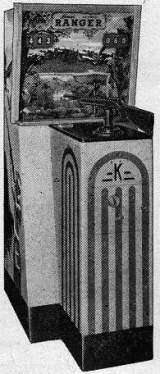
The first one on the right is very difficult. I do not think it is the original paint job. Important to note the black riser section at the bottom is the exact height of some Williams games around 1955, with the cabinet pushing forward in a narrow section in that unique way. The only other company with a similar cab was Keeney, but their game Ranger (1955) doesn't quite match because there is darker colour around the Keeney score reels. That is another thing to note: there are only 3 score reels. Some games then had 4, even if one was a dummy reel.

I am unsure where it at all quite started and who was the first.
In the late 1950s and through the 60s the UK would produce a number of mass gambling machines.
In the 1970s,Taito, Sega and others promoted MiMo systems: Medal In Medal Out systems, where customers could purchase medals to play gambling games with, but there was no cashing them out. (There were places that used these machines illegally to gamble for cash, of course, but the vast majority were legit medal parlors) Medal games are still a huge force today within the Japanese market, and any gambling or game fan visiting Japan should spend time in a medal parlor.
Multi-player gambling devices have always been a staple. Some of the earliest slot machines were designed to accept multiple nickels to allow multiple players to bet at the same time.
 |
| 1904 Peerless Floor Roulette Slot by Caille 7-way action means 7 coins can be played, by 1 to 7 players. |
But what these machines did not have were separate stations for each player. Everyone could crowd around, but there was a single point of access to betting. It would only be later that each player could have their own separate spot where betting and payouts were handled separately for each. Only with separate interfaces do I truly consider them as multiplayer/mass gambling machines.
Caille even butted up against legislation that would limit the number of machines on the floor, creating double (or even triple) machines, but I still do not consider these quite as mass gambling machines as each player does not have their own console.
 |
| 1904 Mills catalog: The Mills Twins 12-way action, allowing nickel play on one side and quarter play on the other. (betting a quarter in 1904 would be like betting $35 today) |
 |
| Penny Roulette by Whittaker |
 |
| Carnival Plaza System flyer from ジャパンオーバーシーズビジネス (Japan Overseas Business) All of the machines advertised were imports from then UK. |
 |
| an example of Taito MiMo machines circa 1975 |

 |
| 6 Bells by Ramsdell |

 |
| 10-player Winterbook console by Ramsdell |