Sunday, October 23, 2022

exploring the arcade in this 1955 Japanese video on candy...

 This video is assumed to be from 1955:


I found it via this tweet from TOO_yoshikawa.  It is a great little video, but there are some pachinko-related rarities to be found.

First we see kids at this pachinko machine.  We can't tell much from the glimpse, but the coin slot at the right means it's a medal pachinko machine  Most machines with the slot there would pay out coins for a win.  But this isn't a video about pachinko, this is a video about CANDY, so I imagine this is a pachinko machine that dispenses sweets on a win.


The camera then cuts to a different machine, giving us wonderful footage of the machine in action!

a win causes a candy to dispense here


If this looks familiar, its because we've seen this machine before, in the Birth of Pachinko Museum by Kazuo Sugiyama:
~1940 子供パチンコ 自動菓子販賣機 (Children's pachinko confectionery vending machine) by セイコー社 (Seiko)

These machines are not gambling or tests of skill.  They are a novelty for the kids to play with.  The ball will fall out the bottom and back to the shooter lane, allowing someone to keep shooting until they hit a winning pocket and receive their confection.


exploring the arcade in ハイティーンやくざ / Hai tiin yakuza / Teenage Yakuza (1962)

via this tweet by TOO_yoshikawa I learned of the movie ハイティーンやくざ which has 2 scenes at a smart ball parlor in it.


ハイティーンやくざ (1962)


The tables being played:

1950s Lucky Ball - ラッキーボール by YMラッキー株式会社 (YM Lucky Co., Ltd.)

I hope I can find more information on the YM company.  Their tables seem quite prolific from the 50s and 60s.

Lucky Ball has come to denote the 4x4 grid configuration we see above, where you can win by completing a row, column, or one of the 2 diagonals.

Here is a better shot of what I think is the same model:


There are a few variations in this style of smart ball.  This one, as in the movie, there is no opening to the front players' trough.  The attendant uses a scoop to serve the balls to players:

Thursday, October 6, 2022

new project: a foreigners' guide to eremeka arcades - 外国人のためのエレメカアーケードゲームガイド

I'm sure you all read about it already over on nazox2016's blog, so it's probably a good time to announce it here as well.  

All throughout 2022 I have been working to build a list of all of the Japanese eremeka games.  What started with an obsession for electromechanical oddities and candystore skill games has spiraled out of control to document a good chunk of Japanese arcade history.

The history of videogames is meticulously documented by an overwhelming army of historians, but I was unable to find a list online of Japanese electromechanical arcade games, let alone a pictures of most of them.  I wanted a list that showed...

  • a game's name (English and Japanese)
  • the year it appeared
  • who made it
  • a decent photo
That's it.  So here it is:

a foreigners' guide to eremeka arcades - 外国人のためのエレメカアーケードゲームガイド


The bulk of information I used came from Onitama, kt2, nazox2016, and the good people of Gaming Alexandria.  There is a much longer list of sources on the page itself.

This is a work in progress and there is still so much to do, but I decided that once I hit 2000 machines documented I would do a "soft launch".  Scroll down to the heading Current Machine List and you will find a text-only version of every machine documented.  This is very useful for just hitting CTRL+F on to find something.  The photo pages are (currently) split into 6 8 different sections: 

  1. machines before 1970   //   1970年以前の機械
  2. machines from 1970-1974  //  1970〜1974年の機械
  3. machines from 1975-1979  //  1975〜1979年の機械
  4. machines from 1980-1989  //  1980〜1989年の機械
  5. machines from 1990-1999  //  1990〜1989年の機械
  6. machines from 2000 and after  //  2000年以降の機械
  7. machines without any year (please help us find any year references!)  //  年のないマシン(年の参照を見つけるのを手伝ってください!) 
  8. machines with no picture  //  写真のないマシン


I still have a lot of material to sift through.  It is an arduous process and I don't want to disclose just how many hours I've poured into this already, but trust me: it's a lot.  When I finish processing the bulk of the materials remaining, I will probably begin tagging all of the machines so that I can generate pages of specific styles of game.

I hope one day someone from Japan decides to make a site like IPDB.org or similar, but for the Japanese games.  I would be able to offer them my data and research for integration.   Until then, this project is the current best hope for documenting these kinds of machines.

There are currently over 2200 machines listed (2023-05-02 update: almost 3500 machines!).  My passion is for the 1970s and earlier, but the materials for machines before 1974 can be extremely sparse and difficult to come across.  Most of the work going forward will be for machines from the 1980s onward, as that is the bulk of the remaining research materials.


On a project like this I have had to set myself some limits, or else I would end up documenting every single Japanese arcade machines ever made.  Maybe someone else will do that, but the thrust of this project is to document all of the machines that I have some interest in, based on flexible criteria that I apply unevenly.

I am including all of the electromechanical medal games, but not all of the modern medal games.  Why?  Most modern medal games are a video slot machine.  I only care about games that have a physical component, and I don't want to consider "dispensing medals" as a physical component here.  There are many large games like horse racing simulators that I am not including, but I am including some modern horse race games that actually have physical horses moving around the track, even though the action itself is all electronically controlled.

I am not including carnival games where you pick up balls and throw them in buckets or baskets.  These came out of the redemption arcades of the 80s and don't interest me.  But I have included some air hockey tables, as they appeared in the electromechanical arcades of the early 70s.

I am not including horoscope and modern novelty machines like photo gimmicks, but I am including old electromechanical ones.  I'm not including most novelty prize games, like string cutters and UFO catchers, but I am including crane games from the 60s and 70s, and their evolutions into the modern age.  I am also including crane games that have novel physical adaptations that interest me, but that's mostly arbitrary.  Rotary merchandisers go back to the 1920s, and more modern versions certainly have a place on my list.  What I'm saying is: it's not a perfect system, but if I can't defend the inclusion or exclusion of something specific, just assume it's because I was exhausted.  :)

One way to think about it: once we hit the IC age (Integrated circuits) my interest diminishes.  If something is from before 1974? My interest piques.

What are you still doing reading this?  Go look at some cool eremeka machines instead.

Thursday, September 22, 2022

2nd bagatelle lecture at the Field House Museum

 This weekend there will be another lecture on bagatelle!  

Ed Nickels will be giving a lecture about his bagatelle collection, 2022-09-24, 1pm CST (2pm EST)


It is Ed Nickels who is showing his collection at the Field House Museum, and I'm very excited to hear the lecture about his collection.  To join via Zoom, you must register in advance here.

The first lecture, by James Masters, is available to watch online!


About this event

Join the Field House Museum on Saturday, September 24, 2022, at 1:00 pm as we welcome avid collector Ed Nickels for a special Speaker Series on Bagatelle. Before the ring of pinball machines echoed through arcades, Bagatelle was filling parlors and pockets across the world. Learn all about this unique collection of intricately decorated and brightly colored tabletop games from the 1800s to early 1900s as Nickels takes an in-depth look at the games on display.

This program is free with limited availability in person and on Zoom. Reservations must be made in advance through Eventbrite, by calling the Museum at 314-421-4689, or by emailing info@fieldhousemuseum.org.


Wednesday, August 24, 2022

Bagatelle - An Evolution lecture at the Field House Museum 2022-08-16

I am delighted to share with you this lecture by James Masters, as given for the Field House Museum (St. Louis, MO, USA) on the history of bagatelle.  

The lecture can be viewed and downloaded on archive.org!

also on youtube:


The lecture was given over Zoom, which ended up being quite ideal since it was attended by people from Canada, USA, UK, Spain, and other countries, as well as a handful of people in person at the museum exhibition itself.

James and I have been writing back and forth for a while know, and he raises a number of key details about the history of bagatelle that have vexed us both:


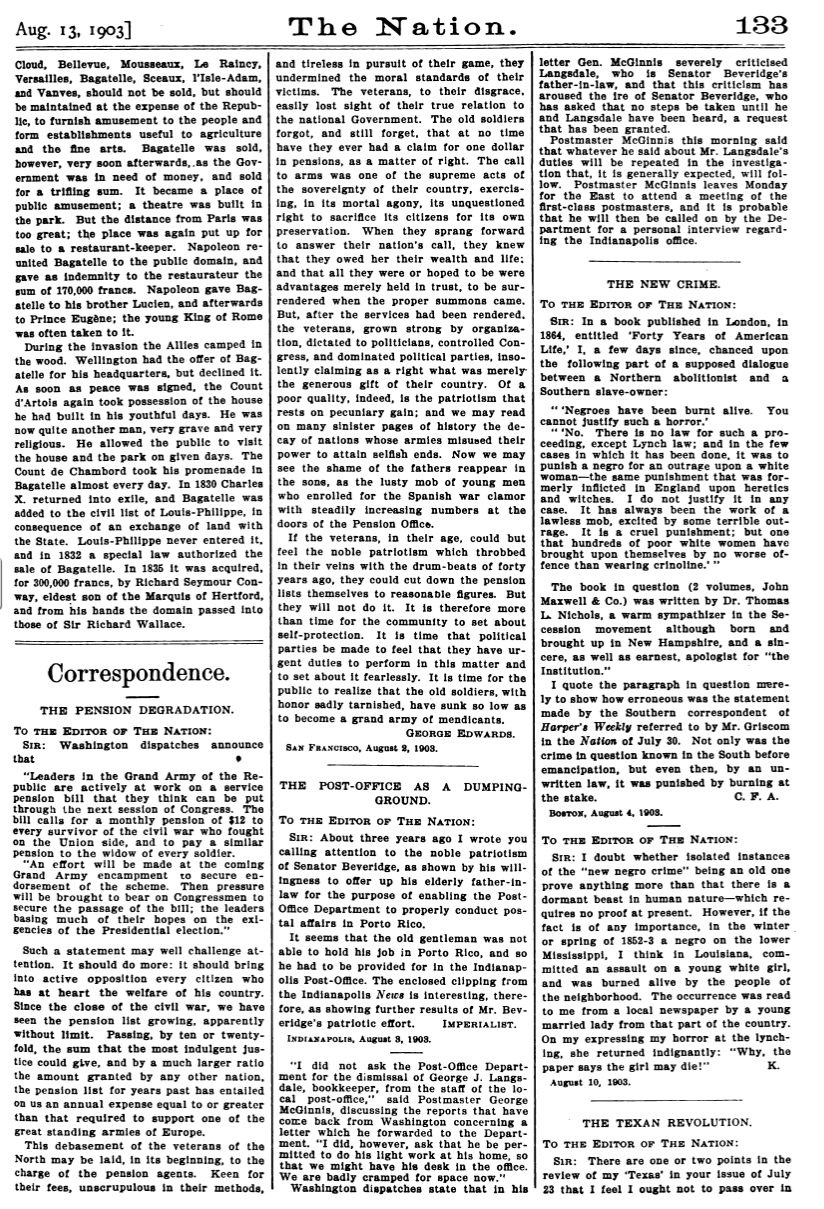
1) we have no proof about there being any sort of pinball precursor at the legendary Chateau de Bagatelle.  There are many references to the Chateau, but none describe a billiards table of any sort, and only a single source makes claim of a "gaming table".    Comte d'Artois was a known gambling addict, but a gaming table can be any table a game is played, and most often cards.  Until we can verify any specific references, it might be best to let this legend fade into history.


Let's returns to the relevant Bueschel quote, sent to me:
"The remarkable coincidence of the appearance of the new betting game of bagatelle at precisely the time that a leading member of the inner court circle and prince of France known as a sportsman and gambler who also"... kept a gaming table in his own house" in a game room of a building called Bagatelle beggars a connection between the man, the party and the game.""

The quote included by Bueschel there is from a 1903 article in The Nation.  I'll include that here!

1903 The Nation: Chateaux Bagatelle

1903 The Nation: Chateaux Bagatelle


2) I appreciate the disentangling of Fossette from the pinball pre-history...


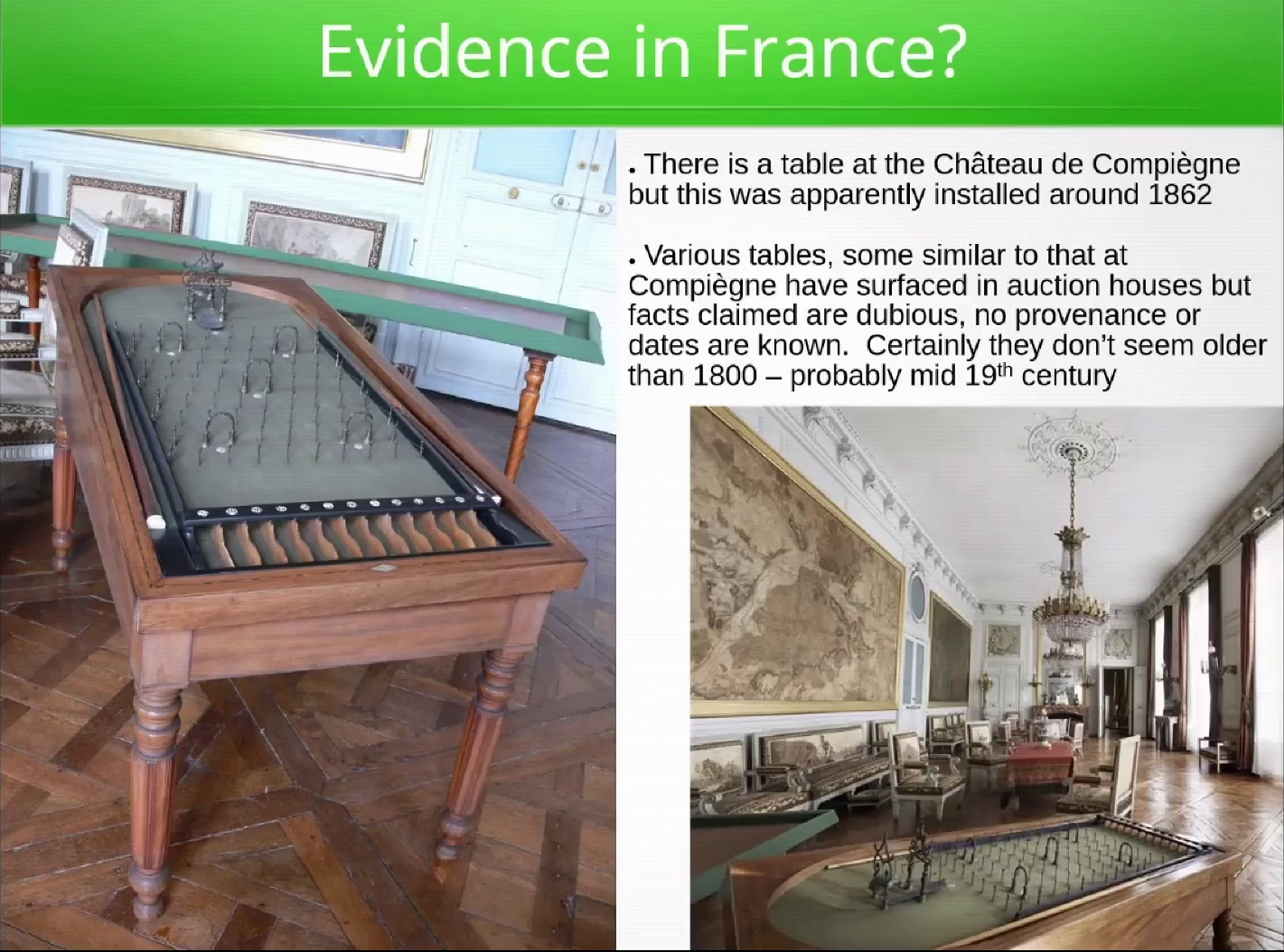
3) Fancy pin tables in France?  Absolutely.  Just not as early as we might have thought.  Or at least, many of the examples that get passed around as "18th century pinball" are known to be 19th century, especially 2nd-half 19th century.


4) There is a table of mystery in the Deutsche Museum that they claim is from 1770-1790, based purely on the materials and build type.  But there is no provenance.


bagatelle notes: 19th century publications

Let's get some definitions and rules!  We're going to sift through 19th century game books here to trace the language around bagatelle and related games.

It's important to note that some of the dates for these books need to be eyed with skepticism as they might not be accurate to the edition.


1801 / 1810 / 1903 The Sports and Pastimes of the People of England from the Earliest Period: Including the Rural and Domestic Recreations, May Games, Mummeries, Pageants, Processions and Pompous Spectacles by Joseph Strutt

this was first published in 1801, but this edition is from 1903 and has had SUBSTANTIAL editing.  If you know where to locate a proper FIRST edition, please do let me know.


I am including this section on Nine-Holes as it seems potentially relevant.  There is an 1896 article in this prior bagatelle post that that also goes in to bumblepuppy.

excerpt from the 1903 edition, but this also is included in the 1810 edition

I am unsure if Troul In Madame is a corruption of Trou Madam or a variant name given specifically due to the play being done with cues/maces, and so a new name needed.
It says it is "not unlike our modern bagatelle, only played without a cue or mace", but while it's exciting that bagatelle is called "modern", note this from the preface:


this passage does not exist in the 1810 version, so we can't use that to date 'bagatelle'

I had forgotten about The Benefit of the Ancient Bathes of Buckstones, but yes that 1572 work did reference Troule in Madame.
Oh hey look it's that 1572 quote:

A friend offered this modern take on the above text,
The Ladies, Gentle Women, Wives and Maids may in one of the Galleries walk: and if the weather be not agreeable to their expectation, they may have in the end of the Bench eleven holes made, into which to "trowle pummetes" or Bowls of lead, big, little or mean [average], or also of Copper, Tin, Wood, either violent or soft, after their own discretion, the pastime Troule in Madame is termed.
Likewise, men feeble, the same may also practice in another Gallery of the new buildings, and this does not only strengthen the stomach and the upper parts above the midriff or waist: but also the middle parts beneath the sharp "Gristle" and the extreme parts, the the hands and legs, according to the weight of the thing "trouled", fast, soft or mean.


This next text might be the earliest description of what we refer to as "pin bagatelle".  All of the critical components are described: curved top, elevated, a channel to drive the ball up, and it falls down "interrupted in its descent by wires inserted at different distances upon the table, which alter its direction and often throw it entirely out of the proper track."  The 'wires' spoken of here probably refers to gates and/or pins.  It also describes the gates used in games like Mississippi for receiving the balls at the bottom.  While we know Trou Madam can be traced to the 16th century, I am unsure as to the origins of the name 'Mississippi'.


This would lend obvious weight to the idea that pin bagatelle arrived by tilting a trou madam / mississippi table so that balls fell down towards the numbered gates to score.
 
From what appears to be the original 1801 edition, a scan done by Google Books:
(the characters that look like a long "f" are actually pronounced as "s".)


2 other Rocks of Scilly references passed to me, which don't offer any real extra details but do give proof of existence.
1804-04-05 The Morning Chronicle (London)

1811-05-06 The Leeds Intelligencer and Yorkshire General Advertiser

Here is the entry on Mississippi from the 1810 edition, where it describes it as a billiard-like game where the balls are 'cast' (rolled) towards a set of arches for points.

I had previously thought Mississippi to be exclusively a cue/mace game, but I suppose it started out with just rolling the balls?  It's hard to tell for sure with just this description to go on.
The only real difference I can tell between Trou Madam and Mississippi is that Trou Madam lets you shoot straight into the scoring holes, while in Mississippi you have to bounce of the side bumper.
(James tells me in a chat, "Earlier tables were not smooth, uniform or level so knocking it straight into a hole was more of a challenge.  As table technology improved and maces changed to cues so accuracy also improved, it became too easy.  So then they added the rule that you had to bounce it off a cushion to make it suitably challenging.")


1847: Castles In The Air vol III by Catherine Grace Francis Gore

This is the earliest mention of the game cockamaroo that we've found so far.
p 246 of Castles In The Air vol III


1854: The Handbook of Games...

1854 Hand-Book of Games, edited by Henry G. Bohn


Pinball Machine Maintenance - Manual For The Repair And Maintenance Of Electro Mechanical Pinball Machine (1960-1977) by Henk De Jager

If you've ever been interested in iterations of EM technology this book is for you.  It's an EM pinball maintenance guide, but it outlines all of the various systems that Bally, Williams, and Gottlieb used over the years, and explains what each improvement in design is doing.  There are very few places to get an understanding of how the technology changed and evolved over the years.

Pinball Machine Maintenance - Manual For The Repair And Maintenance Of Electro Mechanical Pinball Machine (1960-1977) at archive.org