The book is published by Hosei University Press [ISBN978-4-588-21881-1] and is 370 pages of pre-arcade history for all of the Meiji-era fans in your life. :)
My central thesis around Japanese Rolling Ball was that it was the central ancestor of modern day redemption arcades. It directly evolved into Fascination and Pokerino as electricity became available, seems to have inspired the invention of skee-ball, and was used as inspiration for a new type of carnival barker game.
Documenting the birth of the earliest redemption arcade models is, for me, the most important achievement of this research.
Hey it's me! This is now the 2nd book from Japan with my name in it :) But this time my name appears a few more times, and the research I did is spread out through the entire book.
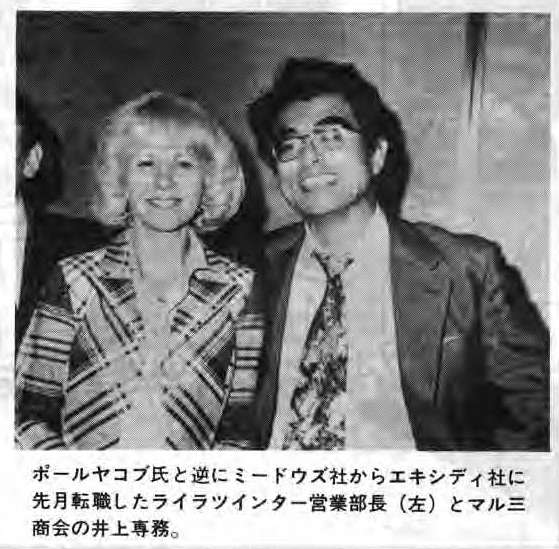
I spotted this image in the Japanese trade magazine Game Machine:
Game Machine - 1977-02-15
It's obviously a composite photo, given the two perspectives. Some editor with a blade lovingly cut out the guy playing Atarians and put that Sea Avenger shot behind him.
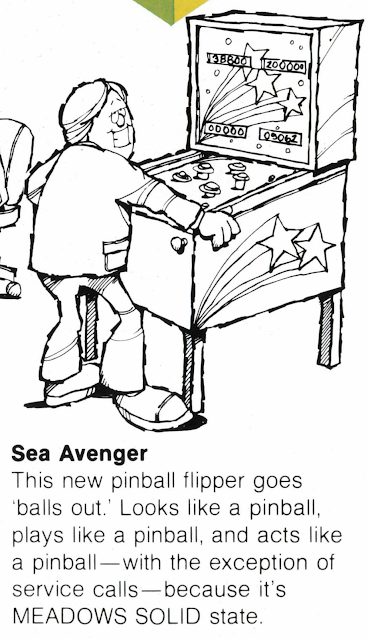
What was this game Sea Avenger? There's not much out there on it.
A few months prior, this advertisement from Meadows Games appears in Play Meter magazine:
Play Meter 1976-11
cropped:
Company info from the flyer:
Meadows Games, Inc
181 Commercial St, Sunnyvale, CA
94086
(800) 538-1515
Sea Avenger was mentioned twice in Cash Box magazine:
Cash Box 1976-11-13
The only quote on the game here was recycled into the Play Meter advertisement we saw above.
This next quote mentions how Lila Zinter went to the ATE show (London tradeshow) with Atari's pinball machine Atarians. It is ambiguous as to if Sea Avenger was with her, but we have other confirmation that Sea Avenger was indeed at the ATE show.
Lila Zinter would soon after go to work for Exidy. She unfortunately passed away in 2016.
Back to the Japanese magazine Game Machine, which included a writeup on the ATE show and not only confirms that Sea Avengers was present, it also gives us a description! You will not be ready for the surprise:
The following is a machine translation, prepped by my friend tweakbod of Gaming Alexandria fame, who also provided some of the research for this article!
Game Machine No. 68 – Feb. 15, 1977 (page 2)
Japanese and U.S. Industries Making Great Strides
New Flippers in the Spotlight
ATARIANS & SEA AVENGER
Atari's Atarians and Meadows' Sea Avenger attracted particular attention in this ATE, as neither of them had attempted a flipper until now. The first machine is an IC flipper from the U.S. TV game machine manufacturer, and this machine attracted attention for its ambitious entry into the flipper market, which was gaining momentum on the back of its strength in TV games.
The main features of Atarians are first, that there is no score display etc. on the backglass, rather all scores are displayed digitally in front of the field, and second, the area of the play field is now much larger than in the past, both vertically and horizontally. The content of the game incorporates many aspects of the flippers, but the feedback we received was that the level of perfection is not good enough.
Sea Avenger, on the other hand, is significantly different from the conventional flipper, with the playfield tilting to the left and right. In addition to the flipper buttons, this feature is activated by pressing a button on the front, which allows a ball on the right to be brought to the left by tilting.
It was unveiled at this ATE as the first machine with its own ingenuity, and it will be interesting to see how it develops in the future.
Game Machine 1978-11-01 says Lila Zinter went from Meadows to Exidy "last month", so perhaps in September or October 1978.
It's a bit hard to believe it, but that's what it says: TILTING PLAYFIELD.
This isn't entirely unprecedented, as the 1970s saw a handful of other pinball machines with playfield novelties like this. Challenger was a long 2-player table and the playfield would tilt between two players.
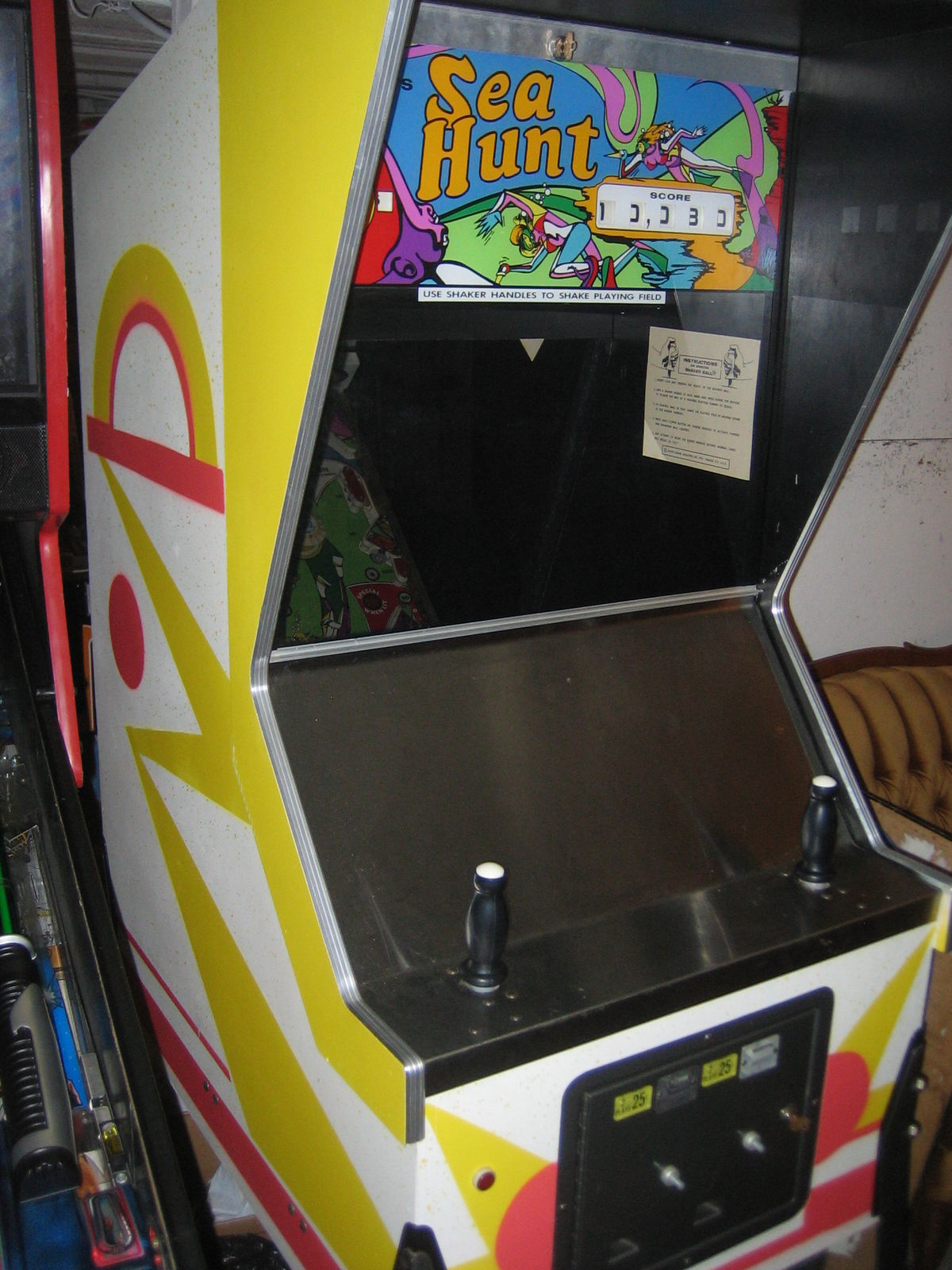
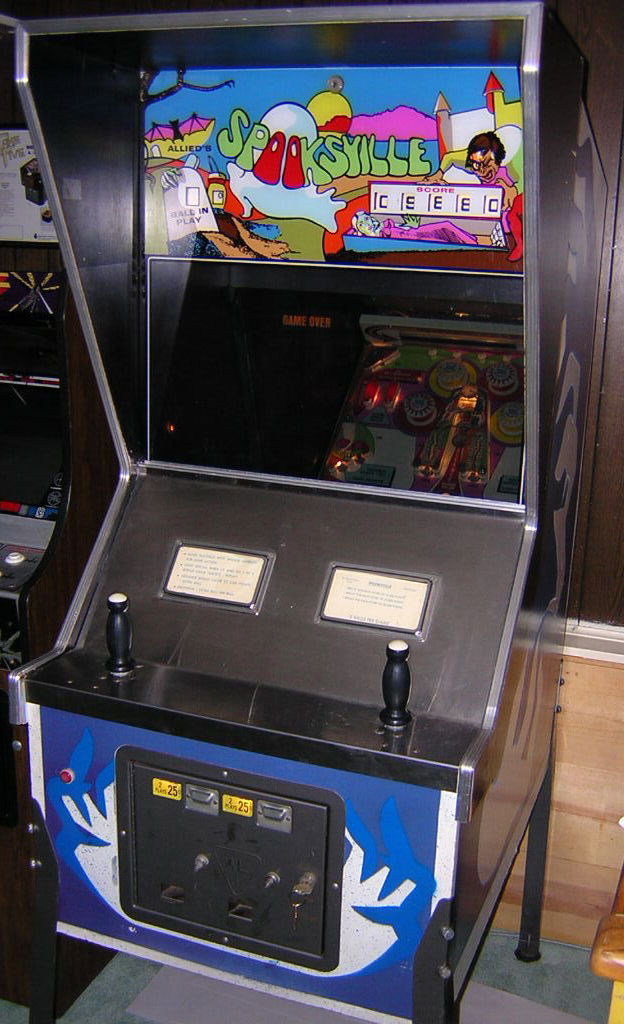
Allied Leisure had two "shaker pins" where you had more freedom to jostle the playfields. This isn't quite the same as tilting, but I'd be remiss to not note their impact here.
The trail on Sea Avenger goes dry after this. I hope to discover some photos are or videos from the ATE show as I don't think the game made it to other trade shows, nor ever made it to production. A button to tilt the playfield left and right was never attempted again by a manufacturer, and perhaps that's a reasonable decision.
The PR quote was that solid state was more reliable? Who knows, but a tilting playfield sounds like an engineering nightmare.
Someone did make a playfield that tilts left and right: TILTY FLASH! In this video, starting at the 18 second mark, you can see a 1978 Flash by Williams that has been modified to tilt back and forth.
Here is a few seconds of gameplay:
It was also pointed out to me that the 1987 game Wolf Man by Peyper has the "El Movimiento" feature, with handles to move the playfield.
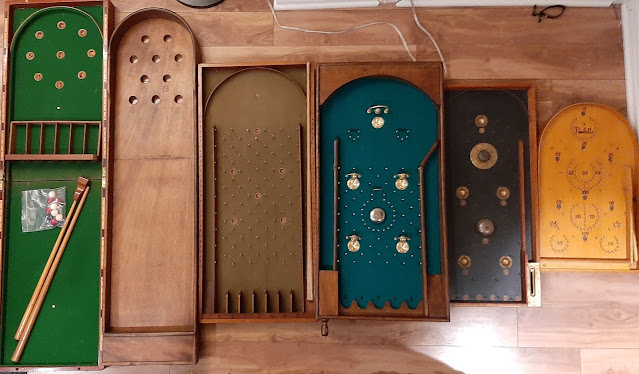
1: English bagatelle / 9 hole bagatelle (UK) 2: Japanese Rolling Ball / Tamakorogashi (Japan) 3: Cockamaroo / French bagatelle (UK) 4: French bagatelle (France) 5: Singer parlor bagatelle (USA) 6: Poolette bagatelle (Japan)
How did we get here?
Well before all of these you'd find the early billiards variants, including trou madam. On table (1) there lies a set of wooden gates, allowing one to play trou madam and similar games on that table. English bagatelle, with the inlaid cups, seems to have sprung up early 1800s.
In the 1870s there is evidence of tables like (1) being made with holes in parallel rows, akin to (2). I think these tables were the inspiration for Japanese Rolling Ball, which came up around 1880 in Japan, 1902 in USA + Canada, and then about 1930 within Europe.
If you note the bottom scoring slots in table (3), you'll they're quite similar to the wooden gates available on (1). A key innovation would be taking a trou madam table and putting it on an incline. Shoot the balls up, and have them fall down in to the separated scoring arches. I am currently unsure if that innovation predates English Bagatelle (1) but it also seems like the kind of innovation that could have happened at in a number of eras and in a number of different areas.
It can be easy enough to infer how the cups of (1) migrated along the playfield of (3), the pigeon hole arches going to the bottom, and then pins added as obstacles.
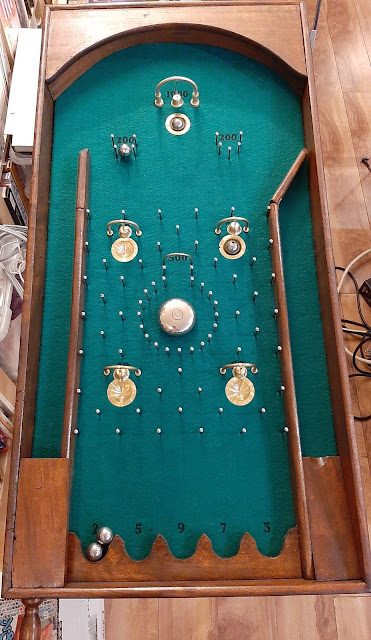
Table (4) adds a spring plunger on one side, and maintains a cue lane on the right-hand side. Table (4) also has arches, which were an accessory to some billiards games going back to the 17th century at least, but were perhaps an innovation that was once again fresh at the time. Bells are also a new addition.
Table (5) does away with the cue altogether, relying exclusively on a spring plunger.
Table (6) is an example of how for some games the cue was kept instead of a spring plunger.
This video is just guessing at the age being 1930s. There is circumstantial evidence that models of these specifications, and with only a few slight variations, were sold at a famous Paris toy store.
Remember this toy 9-hole bagatelle table I picked up? That one at least had the Hamleys plaque on it, and I was able to find it in a picture from an old catalogue.
For this new one, it seems the toy store that commissioned them had their labels in paper, which is very bad at surviving. So we have an inference that this might have been sold at that Parisian toy store, as other copies were. Based on the build and available information about the store, I'd only be confident in giving an estimate of 1900-1920s.
I guess I buried the lede there. I was able to purchase this table from the restorer, and it has safely arrived from France.
Ball sizes
The game arrived with ~19.9mm steel balls, approx 25/32". This would require a very full plunge to get some action from the spring plunger. Steel balls would also not be good to launch with a cue from the right lane.
I tried 7/8" balls, which are 22.23mm, but those were too large. If one ball was in a brass cup, another could be caught between the ball and the gate post. I tried plastic balls and marbles, and using light balls made the plunge much better.
I have begun using 3/4" marbles. That works fine for now, but 3/4" is 19.05 mm. I would like to try and find some more appropriate balls that get up to the 19.9mm size, if possible
This next one I was involved with. I imported this magazine issue from Japan. It covers Stern Pinball during their lowest years as the entire industry was almost dead. (Be sure to flip the pages to the left, as it's read right-to-left.)
I saw this machine on YJA and eventually it was reposted at a good enough price that I had to go for it. I am delighted that it arrived unscathed. I've used companies like Buyee and FromJapan to get machines from Japan to Canada and so far the shipping services have been amazing. (knock wood for good luck here)
In this post I want to look at what led us to arrangeball machines, and a bit more about this style of arrangeball in particular.
I am currently working on creating a list of all of the elecmeca arcade games made in Japan. That is a somewhat loose category which includes the mechanical & electromechanical, and basically just think of any kind of non-videogame arcade machine that you'd never be able to play on an emulator. Part of that push is cataloguing all of the token-based and prize-based pachi machines, which includes arrangeballs.
So here's an ask for everyone: If you have access to an arrange ball machine, I am super interested in your taxation tags to help determine the date it was manufactured. If your machine has any manufacturer information pointing to date or company, maybe on components inside, that is useful too. Please let me know!
Pre-ww2, around the late 1920s, the earliest pachinko-style machines wouldn't award anything. If you got it in a winning hole an operator would release it from the rear and most likely hand you a prize. Some of the earliest payout machines would pay out sen coins. Some pachinko-style games in the 1930s would pay out confectionary items. By far the most common, standard pachinko machines would pay out in more pachinko balls.
~1940 子供パチンコ 自動菓子販賣機 (Children's pachinko confectionery vending machine) by セイコー社 (Seiko) This is a candy vending machine for kids where they will always get a prize. There is no "out hole". You will see that a missed ball always returns to the player.